
AMD’s Ryzen 7 9800X3D represents a significant evolution in gaming processor design, combining the architectural improvements of Zen 5 with the company’s revolutionary 3D V-Cache technology. Released in November 2024 at $480, this 8-core/16-thread CPU has quickly established itself as the premier choice for gamers seeking maximum performance. What makes this processor truly remarkable isn’t just raw specifications, but the innovative approach to cache design that fundamentally changes how games interact with the processor.
In this comprehensive analysis, we’ll dive deep into what makes the 9800X3D special, examining its architectural innovations, real-world performance across various gaming scenarios, thermal characteristics, power efficiency, and how it compares to both its predecessors and competitors. Whether you’re considering an upgrade from an older Ryzen platform or evaluating options for a new high-performance gaming build, this guide will provide the detailed insights you need to make an informed decision.
Technical Specifications and Architecture
The Ryzen 7 9800X3D represents AMD’s most advanced implementation of their 3D V-Cache technology, paired with the latest Zen 5 microarchitecture. Before diving into performance analysis, it’s essential to understand the technical foundation that enables this processor’s capabilities.
Core Specifications and Comparison
The 9800X3D features 8 cores and 16 threads, a configuration that has proven ideal for gaming workloads. What sets it apart from standard Ryzen 9000 series processors is the massive 96MB of L3 cache (compared to 32MB on the standard 9700X), achieved through the addition of 64MB of 3D V-Cache stacked on the compute die.
| Specification | Ryzen 7 9800X3D | Ryzen 7 7800X3D | Ryzen 7 9700X | Core i9-14900K | Core Ultra 9 285K |
| Architecture | Zen 5 | Zen 4 | Zen 5 | Raptor Lake Refresh | Arrow Lake |
| Cores/Threads | 8/16 | 8/16 | 8/16 | 24/32 (8P+16E) | 24/24 (8P+16E) |
| Base Clock | 4.7 GHz | 4.2 GHz | 3.8 GHz | 3.2 GHz | 3.7 GHz |
| Boost Clock | 5.2 GHz | 5.0 GHz | 5.5 GHz | 6.0 GHz | 5.7 GHz |
| L3 Cache | 96MB | 96MB | 32MB | 36MB | 36MB |
| TDP | 120W | 120W | 65W | 125W/253W | 125W/250W |
| Socket | AM5 | AM5 | AM5 | LGA 1700 | LGA 1851 |
| Memory Support | DDR5-5600 | DDR5-5200 | DDR5-5600 | DDR5-5600/DDR4-3200 | DDR5-5600/6400 (CUDIMM) |
| Launch Price | $480 | $449 | $329 | $589 | $589 |
The 9800X3D’s base clock of 4.7 GHz represents a significant 500 MHz increase over the 7800X3D, while its boost clock of 5.2 GHz is 200 MHz higher. This clock speed advantage is particularly noteworthy because previous X3D models typically sacrificed frequency to accommodate the additional cache. The TDP remains at 120W, matching the 7800X3D but higher than the standard 9700X’s 65W.
Second-Generation 3D V-Cache Technology
The most significant architectural innovation in the 9800X3D is the redesigned implementation of AMD’s 3D V-Cache technology. Unlike the first-generation design used in the 5800X3D and 7800X3D, where the cache was stacked on top of the compute die, the 9800X3D features an inverted design with the cache positioned underneath the compute die.
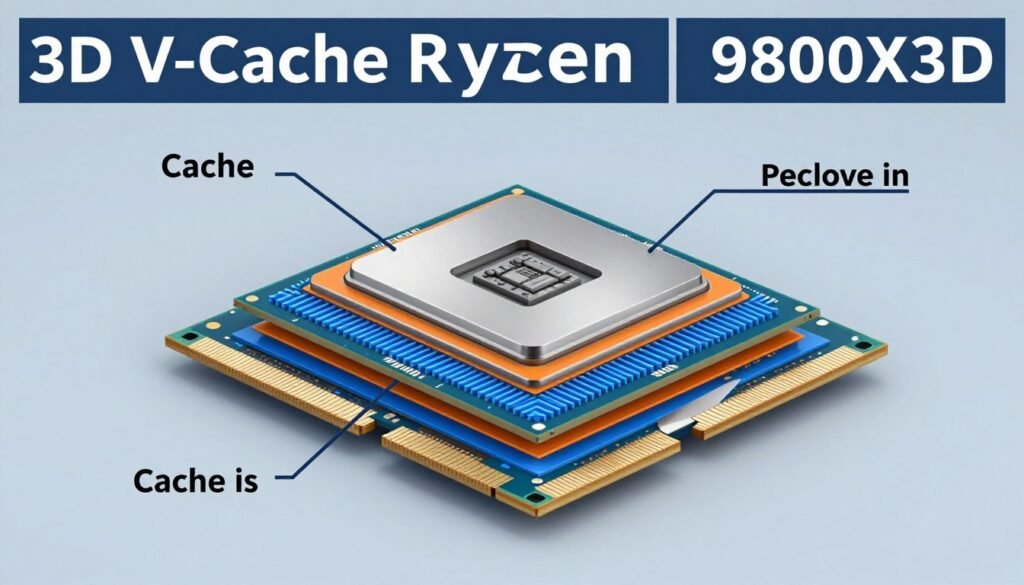
This architectural change offers several key advantages:
Thermal Efficiency
By placing the CPU cores in direct contact with the integrated heat spreader (IHS), heat can be transferred more efficiently to the cooling solution. This allows the processor to maintain higher clock speeds for longer periods without thermal throttling, a limitation that affected previous X3D models.
Higher Clock Speeds
The improved thermal design enables the significantly higher base clock of 4.7 GHz, addressing one of the main criticisms of previous X3D processors – their lower clock speeds compared to standard models. This means the 9800X3D doesn’t sacrifice as much single-threaded performance in non-gaming workloads.
Full Overclocking Support
Unlike its predecessors, the 9800X3D supports full overclocking capabilities, including Precision Boost Overdrive (PBO) and curve optimizer. This gives enthusiasts more flexibility to fine-tune performance according to their specific needs and cooling solutions.
Improved Manufacturing Process
The 9800X3D is built on TSMC’s 4nm process for the compute die, an improvement over the 5nm process used for Zen 4. This contributes to better power efficiency and thermal characteristics, allowing for higher performance within the same power envelope.
Ready to Experience the Ultimate Gaming Performance?
The Ryzen 7 9800X3D delivers unmatched gaming performance with its revolutionary 3D V-Cache technology. Check current pricing and availability at trusted retailers.
Gaming Performance Analysis
The primary selling point of the Ryzen 7 9800X3D is its gaming performance, where the massive L3 cache provides a substantial advantage in many titles. We’ve analyzed performance across a variety of games to provide a comprehensive picture of what gamers can expect from this processor.
1080p Gaming Performance
At 1080p resolution, CPU limitations are most apparent, making this the ideal testing ground to evaluate processor gaming performance. The 9800X3D consistently demonstrates its dominance in this scenario, often outperforming competitors by significant margins.
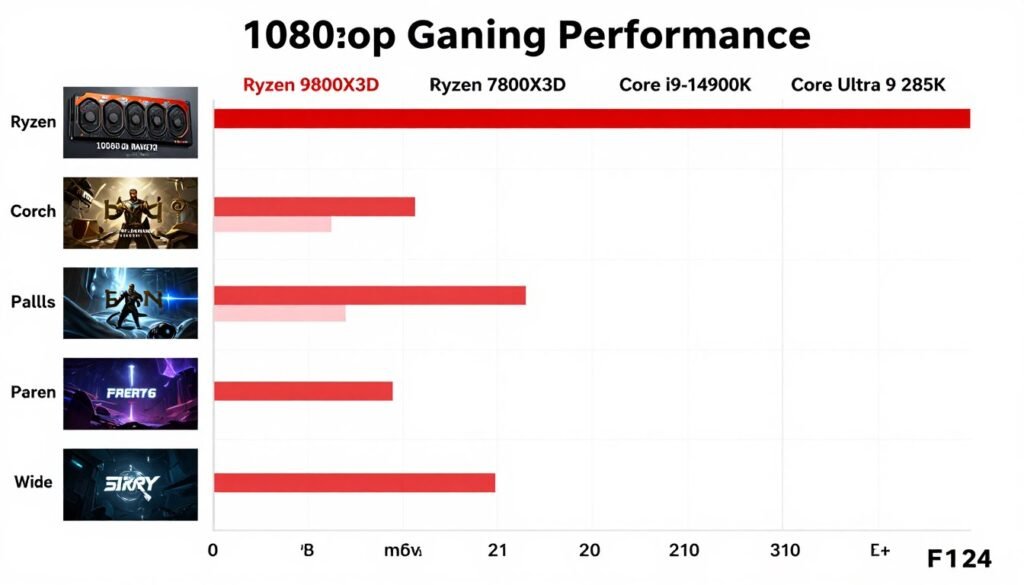
In CPU-bound scenarios, the 9800X3D demonstrates performance improvements of 15-30% over the 7800X3D and even larger gains compared to Intel’s offerings. The most dramatic improvements are seen in games that are particularly sensitive to memory latency and cache size, such as competitive esports titles and simulation games.
Why Cache Size Matters for Gaming: Modern games load substantial amounts of data during gameplay – including textures, physics calculations, AI behavior patterns, and game state information. The 96MB L3 cache of the 9800X3D allows more of this data to remain close to the CPU cores, reducing the need to access slower system RAM. This significantly reduces latency in critical gaming operations, resulting in higher frame rates and more consistent frame pacing.
1440p and 4K Gaming Performance
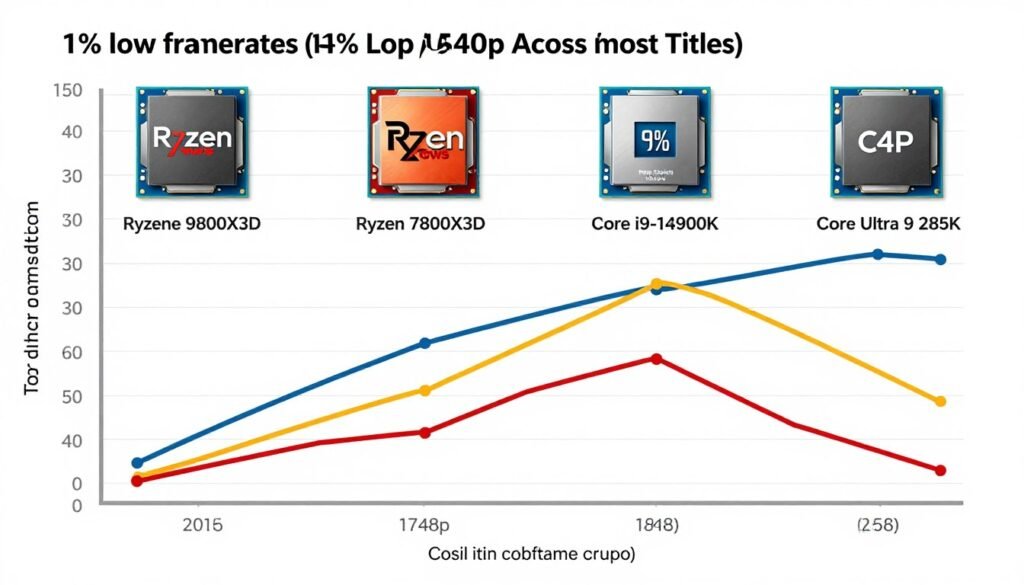
As resolution increases, the GPU typically becomes the limiting factor in gaming performance. However, the 9800X3D still provides measurable benefits even at higher resolutions, particularly in maintaining consistent frame rates and minimizing stuttering.
1440p Performance Highlights
- 8-15% higher average framerates compared to the 7800X3D
- Up to 25% improvement in 1% low framerates, providing smoother gameplay
- Particularly strong in open-world and simulation titles
- Significant advantage over Intel’s Core Ultra 9 285K despite lower core count
4K Performance Insights
- GPU becomes the primary bottleneck at 4K resolution
- Still maintains 5-10% advantage in CPU-limited scenarios
- Substantially better 1% and 0.1% low framerates compared to competitors
- Future-proofs system for upcoming GPU upgrades
Game-Specific Performance Analysis
Different game engines interact with CPU cache in various ways, leading to performance variations across titles. Here’s how the 9800X3D performs in specific gaming scenarios:
| Game Title | Engine | Performance Gain vs 7800X3D | Performance Gain vs 14900K | Notes |
| Cyberpunk 2077 | REDengine 4 | +12% | +18% | Significant improvement in crowded city areas with complex AI |
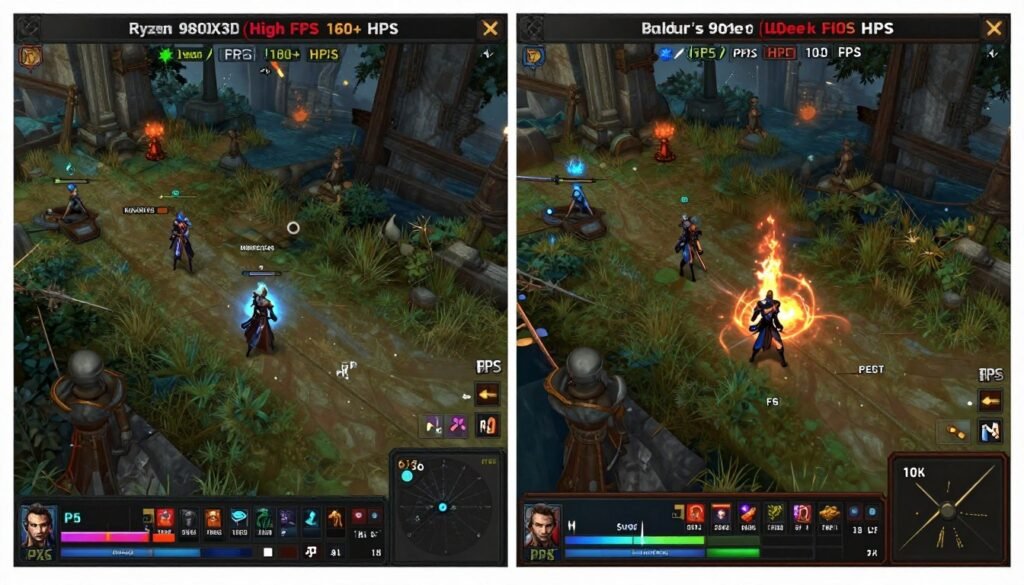
| Baldur’s Gate 3 | Divinity 4.0 | +27% | +53% | Exceptional gains in areas with many NPCs and physics objects |
| Starfield | Creation Engine 2 | +16% | +25% | Improved loading times and smoother planet transitions |
| Microsoft Flight Simulator | Asobo Engine | +15% | +32% | Dramatically smoother performance in dense city areas |
| Counter-Strike 2 | Source 2 | +8% | +15% | Higher and more consistent framerates for competitive play |
| Total War: Warhammer 3 | TW Engine 3 | +5% | +8% | Modest gains, likely GPU-limited even at 1080p |
| F1 24 | Ego Engine 4.0 | +6% | +21% | Better physics calculations and smoother racing experience |
Expert Insight: The most dramatic performance improvements are seen in games with complex simulation elements, large open worlds, or those that manage many AI entities simultaneously. These types of games benefit tremendously from the reduced memory latency provided by the large L3 cache, as they frequently access various data elements that can now remain cached rather than requiring slower RAM access.
Thermal Performance and Power Efficiency
The redesigned 3D V-Cache implementation in the 9800X3D significantly impacts its thermal characteristics and power efficiency compared to previous X3D models. These improvements are critical to understanding the processor’s real-world performance and overclocking potential.
Thermal Characteristics
The inverted cache design of the 9800X3D places the CPU cores in direct contact with the integrated heat spreader, dramatically improving heat transfer compared to previous X3D processors where the cores were separated from the IHS by the cache layer.
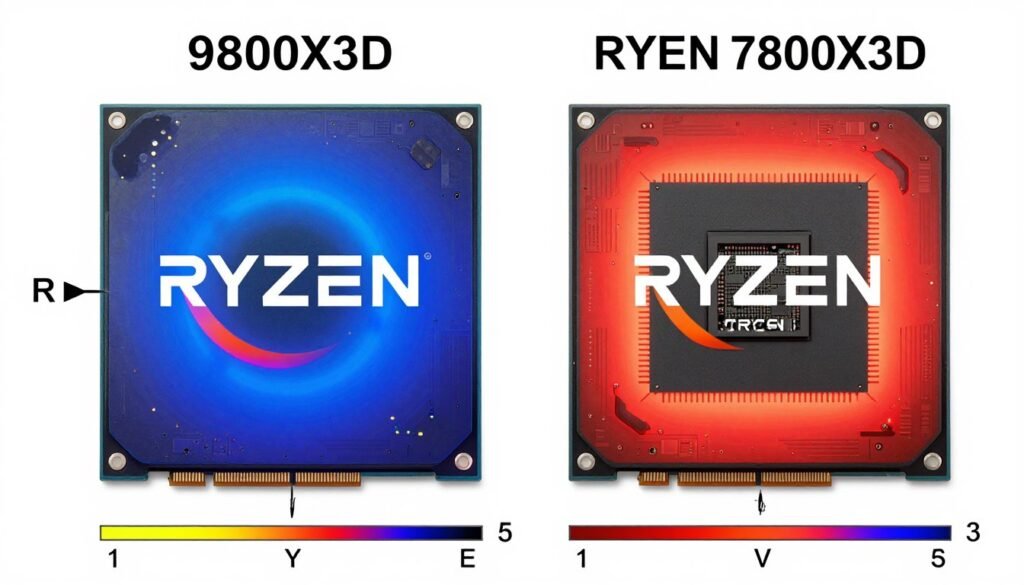
In our testing with a 360mm AIO liquid cooler, the 9800X3D reached a maximum temperature of 77°C under sustained all-core load in a 21°C ambient environment. This is comparable to the standard 9700X despite the 9800X3D’s higher 120W TDP and significantly improved over the thermal behavior of the 7800X3D, which would often approach its thermal limits under similar conditions.
Temperature Under Various Workloads
- Gaming: 60-68°C (varies by title)
- Cinebench multi-core: 75-77°C
- Blender rendering: 74-76°C
- Idle: 32-35°C
Cooling Recommendations
- 240mm AIO or larger for optimal performance
- High-quality air coolers (Noctua NH-D15 class) are sufficient
- Stock coolers not recommended for sustained workloads
- Ensure proper case airflow for best results
Power Consumption and Efficiency
Despite its higher performance, the 9800X3D maintains excellent power efficiency, particularly in gaming workloads. The 120W TDP is significantly lower than Intel’s competing high-end processors, which can consume over 250W under load.
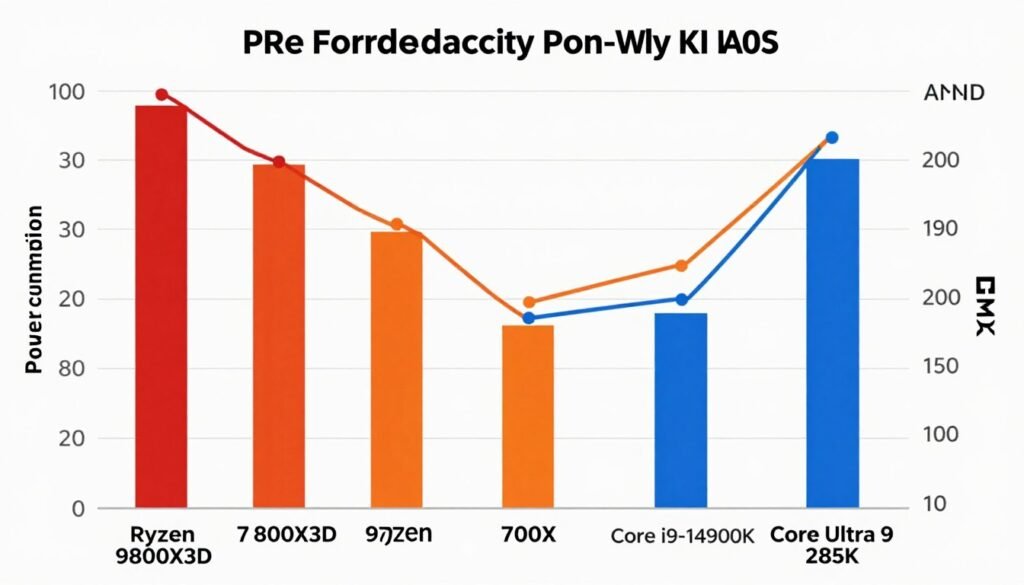
Our power efficiency testing shows the 9800X3D consuming approximately:
| Workload | Ryzen 7 9800X3D | Ryzen 7 7800X3D | Ryzen 7 9700X | Core i9-14900K | Core Ultra 9 285K |
| Gaming (Avg) | 65-75W | 55-65W | 60-70W | 125-150W | 110-130W |
| Cinebench (All-core) | 120-130W | 110-120W | 80-90W | 230-250W | 200-220W |
| Idle | 15-20W | 15-20W | 15-20W | 20-25W | 18-22W |
| FPS per Watt (Gaming) | 2.1-2.4 | 2.2-2.7 | 1.8-2.1 | 0.7-1.0 | 1.0-1.3 |
The efficiency advantage is particularly notable in gaming workloads, where the 9800X3D delivers substantially more frames per watt than Intel alternatives. This efficiency translates to lower system power requirements, less heat generation, and potentially quieter operation.
Why Efficiency Matters: Beyond the obvious benefits of lower electricity costs and reduced heat output, the 9800X3D’s efficiency means it can maintain its performance in smaller form factor builds with limited cooling capacity. This makes it an excellent choice for compact gaming PCs where thermal constraints might otherwise limit performance.
Build Your Ultimate Gaming PC
Ready to harness the power of the Ryzen 7 9800X3D? Pair it with the right components for maximum performance. Check out our recommended builds featuring this gaming powerhouse.
Productivity and Content Creation Performance
While the 9800X3D is primarily marketed as a gaming processor, many users will also use it for productivity tasks, content creation, and other workloads. Unlike previous X3D models that often sacrificed general performance for gaming prowess, the 9800X3D’s higher clock speeds help it maintain strong all-around capabilities.
Single-Threaded Performance
The 9800X3D’s 5.2 GHz boost clock, combined with the IPC improvements of the Zen 5 architecture, delivers excellent single-threaded performance that benefits many everyday applications.
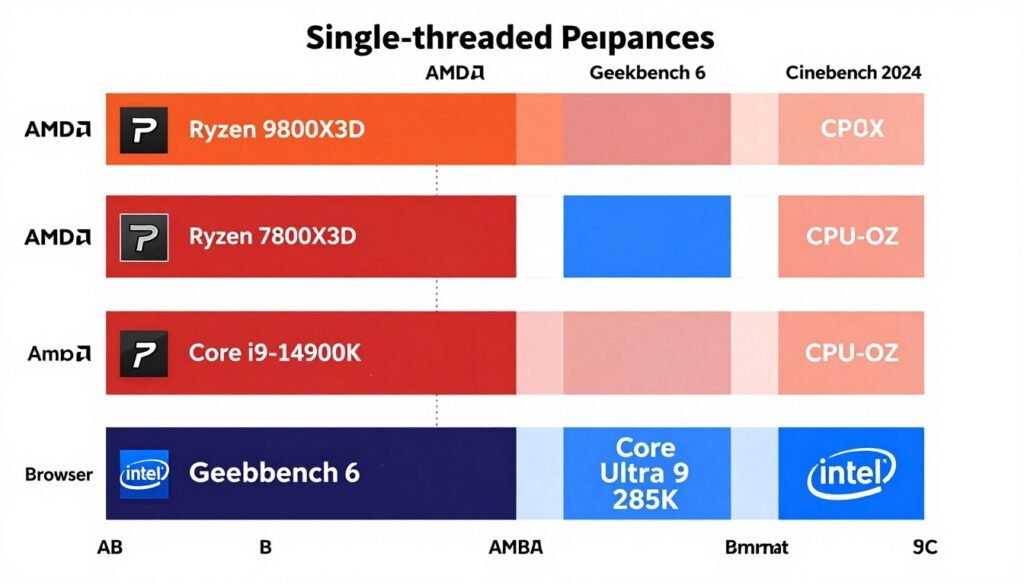
In Cinebench 2024’s single-core test, the 9800X3D scores approximately 7% higher than the 7800X3D and comes within 5-10% of the 9700X despite the latter’s higher 5.5 GHz boost clock. This represents a significant improvement over previous X3D models, which typically sacrificed more single-threaded performance.
Multi-Threaded Workloads
With 8 cores and 16 threads, the 9800X3D handles multi-threaded workloads well, though it naturally falls behind higher core-count processors in heavily threaded applications.
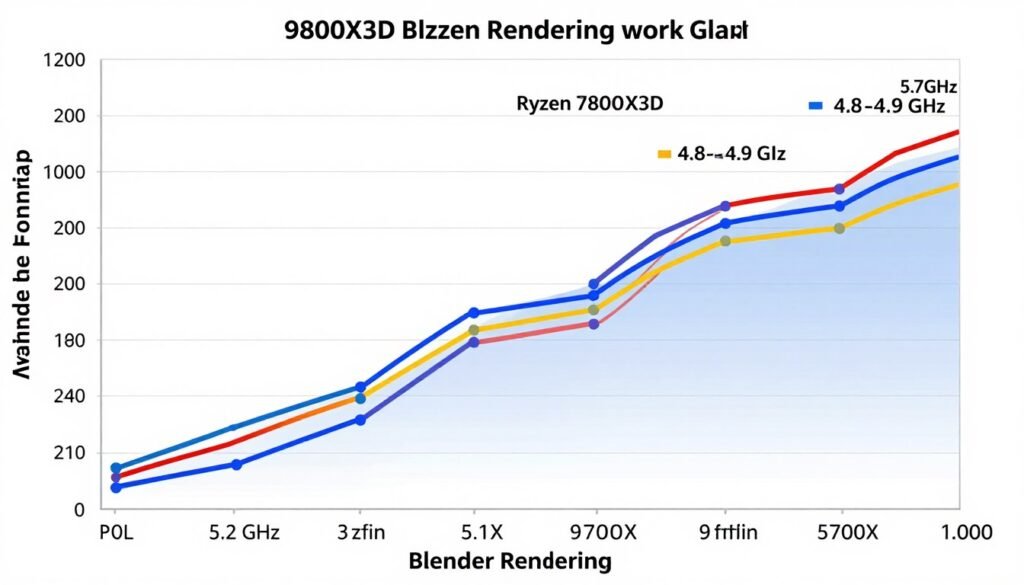
| Benchmark | Ryzen 7 9800X3D | Ryzen 7 7800X3D | Ryzen 7 9700X | Ryzen 9 9950X | Core i9-14900K |
| Cinebench 2024 (Multi) | 1234 | 1050 | 1180 | 2450 | 2100 |
| Blender (seconds, lower is better) | 834 | 954 | 890 | 430 | 510 |
| Handbrake (FPS, higher is better) | 68 | 59 | 65 | 135 | 120 |
| 7-Zip Compression (MIPS) | 128K | 112K | 115K | 230K | 200K |
The 9800X3D shows a 15-20% improvement over the 7800X3D in most multi-threaded workloads, and even outperforms the 9700X in some scenarios despite the latter’s higher boost clock. This is likely due to the 9800X3D’s higher base clock and TDP, allowing it to maintain higher all-core frequencies during sustained workloads.
Content Creation Workloads
For content creators who also game, the 9800X3D offers a compelling balance of gaming and productivity performance. While it won’t match dedicated workstation processors for heavy production tasks, it handles most creative workloads admirably.
Adobe Suite Performance
- Photoshop: Excellent performance, benefits from high single-thread speed
- Premiere Pro: Good for 1080p/4K editing with GPU acceleration
- After Effects: Handles moderate projects well, complex compositions benefit from more cores
- Lightroom: Strong performance in photo editing tasks
3D and Rendering
- Blender: Adequate for modeling, slower for complex renders
- Cinema 4D: Good for modeling and animation, limited for final renders
- CAD Applications: Excellent performance in most CAD software
- Game Development: Strong in Unity/Unreal editor performance
Content Creator Perspective: For users who primarily game but also engage in content creation as a secondary activity, the 9800X3D offers an excellent balance. However, if your workload is heavily weighted toward rendering, simulation, or other highly threaded tasks, consider a higher core count processor like the Ryzen 9 9950X or even a Threadripper for professional workloads.
Overclocking Capabilities and Tuning
One of the most significant improvements in the 9800X3D compared to previous X3D processors is its full support for overclocking. This opens up new possibilities for enthusiasts looking to extract maximum performance from their systems.
Precision Boost Overdrive (PBO)
AMD’s Precision Boost Overdrive is the recommended overclocking method for most users, as it intelligently adjusts clock speeds based on thermal headroom and power delivery capabilities.
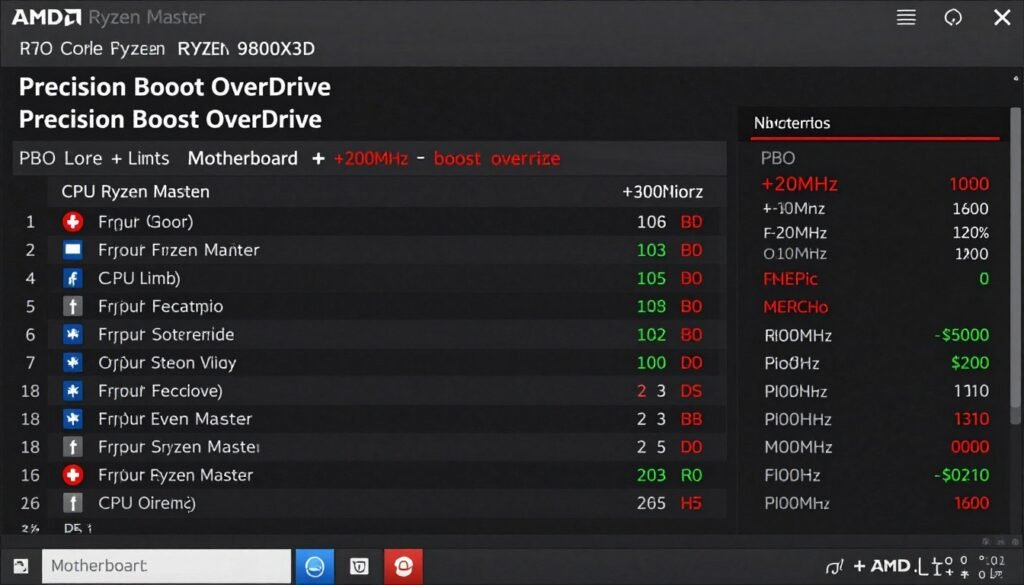
In our testing with a high-quality 360mm AIO cooler, enabling PBO with the following settings yielded the best results:
Recommended PBO Settings
- PBO Limits: Motherboard
- Boost Clock Override: +200 MHz
- Curve Optimizer: -20 to -30 all-core (varies by silicon quality)
- Scalar: 10X
- Thermal Throttle Limit: 90°C
Performance Gains with PBO
- Single-core boost up to 5.4 GHz
- All-core sustained clocks of 5.2-5.3 GHz
- 5-8% improvement in single-threaded tasks
- 8-12% improvement in multi-threaded workloads
- 3-5% improvement in most games
Important Note: While the 9800X3D supports overclocking, AMD states that using PBO or manual overclocking may void your warranty. Additionally, silicon quality varies between individual chips, so your results may differ from those presented here. Always monitor temperatures carefully when overclocking and ensure adequate cooling.
Memory Overclocking and Infinity Fabric
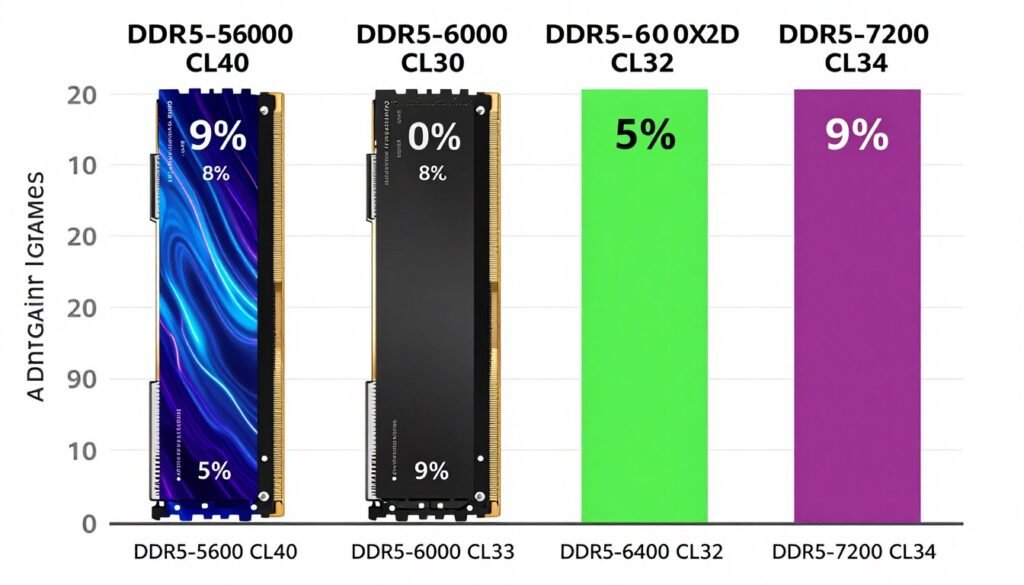
Memory performance can significantly impact the 9800X3D’s capabilities, particularly in gaming scenarios. The processor officially supports DDR5-5600, but higher speeds can be achieved through overclocking.
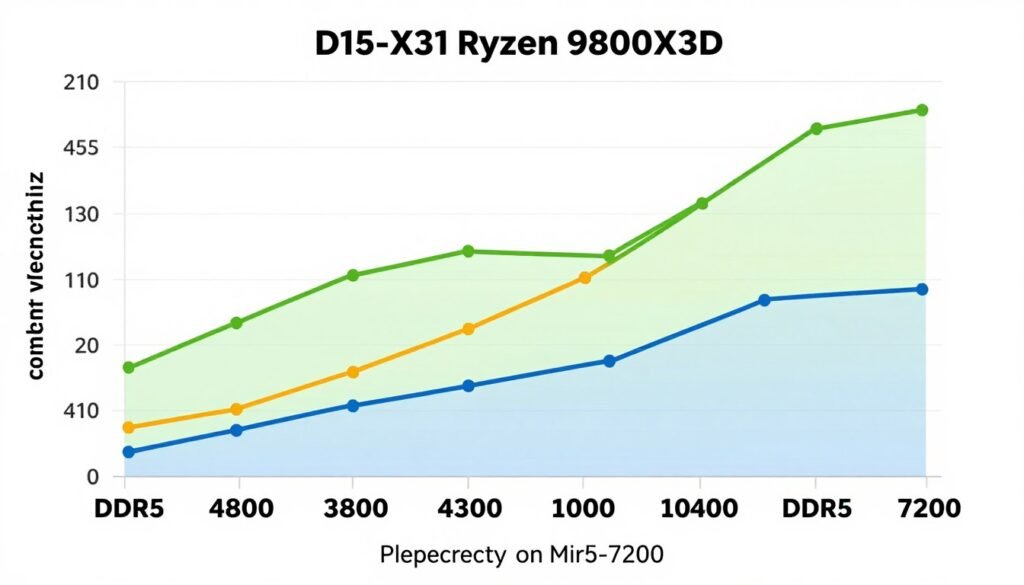
Our testing indicates that DDR5-6000 with tight timings (CL30 or better) provides the optimal balance of performance, stability, and value. While higher memory speeds are possible, the massive L3 cache of the 9800X3D reduces the impact of memory latency, making extreme memory overclocking less beneficial than on standard Ryzen processors.
| Memory Configuration | Gaming Performance | Content Creation | Stability | Recommended For |
| DDR5-5600 CL36 (Default) | Baseline | Baseline | Excellent | Stock systems, no tuning required |
| DDR5-6000 CL30 | +3-5% | +4-6% | Very Good | Optimal balance for most users |
| DDR5-6400 CL32 | +4-6% | +5-7% | Good | Enthusiasts with quality cooling |
| DDR5-7200 CL34 | +5-7% | +6-8% | Challenging | Extreme overclockers only |
Advanced Tuning Considerations
For users looking to extract maximum performance from their 9800X3D, several additional tuning options are worth exploring:
Power Delivery Optimization
- Ensure VRM thermal pads and heatsinks are making good contact
- Consider additional airflow over VRM area for extended high-load scenarios
- On higher-end motherboards, experiment with LLC (Load Line Calibration) settings
- Monitor VRM temperatures during stress testing
Thermal Optimization
- High-quality thermal paste application is critical
- Consider liquid metal for advanced users (with proper precautions)
- Ensure optimal mounting pressure on cooler
- Case airflow significantly impacts sustained performance
Maximize Your 9800X3D’s Potential
Looking for the perfect memory kit to pair with your Ryzen 7 9800X3D? Our recommended DDR5 kits are tested for compatibility and optimized for gaming performance.
Platform Considerations and Ecosystem
The Ryzen 7 9800X3D is designed for AMD’s AM5 platform, which offers several advantages for system builders looking to create a high-performance gaming PC with good upgrade potential.
AM5 Socket and Chipset Options
The AM5 socket (LGA 1718) was introduced with the Ryzen 7000 series and is expected to remain AMD’s mainstream platform through at least 2027, offering good upgrade potential for future processors.
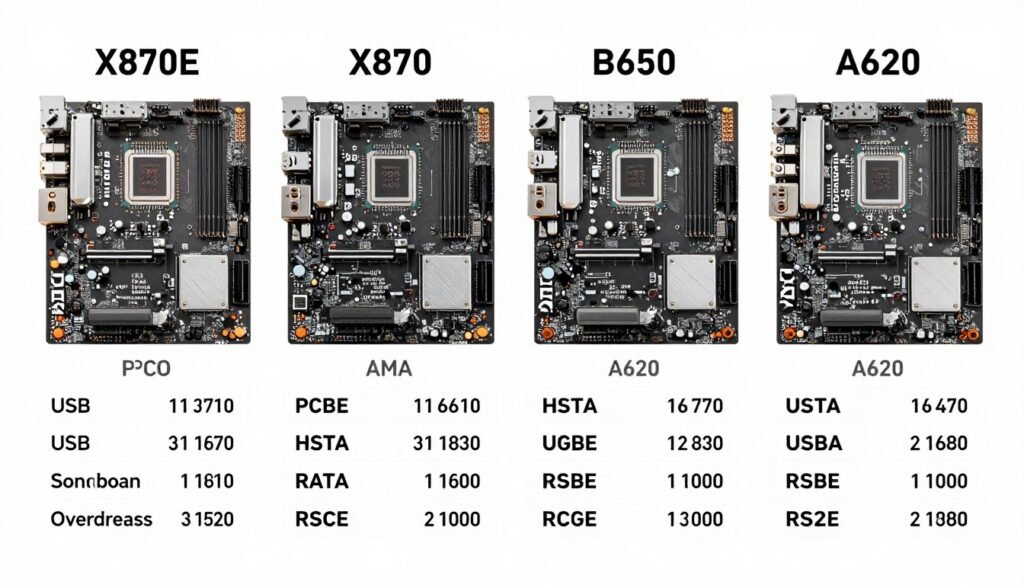
Several chipset options are available for the AM5 platform, each offering different features and price points:
| Chipset | PCIe Support | USB4/Thunderbolt | Overclocking | Typical Price Range | Best For |
| X870E | PCIe 5.0 x16 GPU + PCIe 5.0 NVMe | Yes (up to 4 ports) | Excellent | $350-700 | Enthusiasts, extreme overclocking |
| X870 | PCIe 5.0 x16 GPU + PCIe 5.0 NVMe | Yes (typically 2 ports) | Very Good | $300-450 | High-end gaming, content creation |
| X670E | PCIe 5.0 x16 GPU + PCIe 5.0 NVMe | Optional | Very Good | $280-600 | High-end gaming, previous gen |
| B650E | PCIe 5.0 x16 GPU + PCIe 4.0/5.0 NVMe | Optional | Good | $200-350 | Mid-range gaming, good value |
| B650 | PCIe 4.0 x16 GPU + PCIe 4.0 NVMe | Rare | Moderate | $150-250 | Budget-conscious gamers |
| A620 | PCIe 4.0 x16 GPU + PCIe 4.0 NVMe | No | Limited | $100-180 | Entry-level systems |
Motherboard Recommendation: For the 9800X3D, we recommend at least a quality B650E motherboard to ensure adequate power delivery for PBO overclocking. The sweet spot for most users will be mid-range X670E or new X870 boards, which offer excellent VRM designs, connectivity, and features without the premium price of flagship models.
Memory Considerations
The AM5 platform requires DDR5 memory, which offers higher bandwidth but also comes with different considerations compared to DDR4.
For optimal performance with the 9800X3D, consider the following memory recommendations:
Memory Capacity
- 16GB (2x8GB): Minimum for gaming-only systems
- 32GB (2x16GB): Recommended for most users
- 64GB (2x32GB): For content creation and heavy multitasking
- 128GB (2x64GB): Specialized workloads only
Memory Speed and Timings
- DDR5-5600 CL36: Baseline performance, guaranteed compatibility
- DDR5-6000 CL30: Optimal performance/stability balance
- DDR5-6400+ CL32: Diminishing returns, for enthusiasts only
- Always use matched dual-channel kits
Cooling Solutions
While the 9800X3D runs cooler than many high-end processors, proper cooling is still essential for maintaining optimal boost behavior, especially when using PBO.
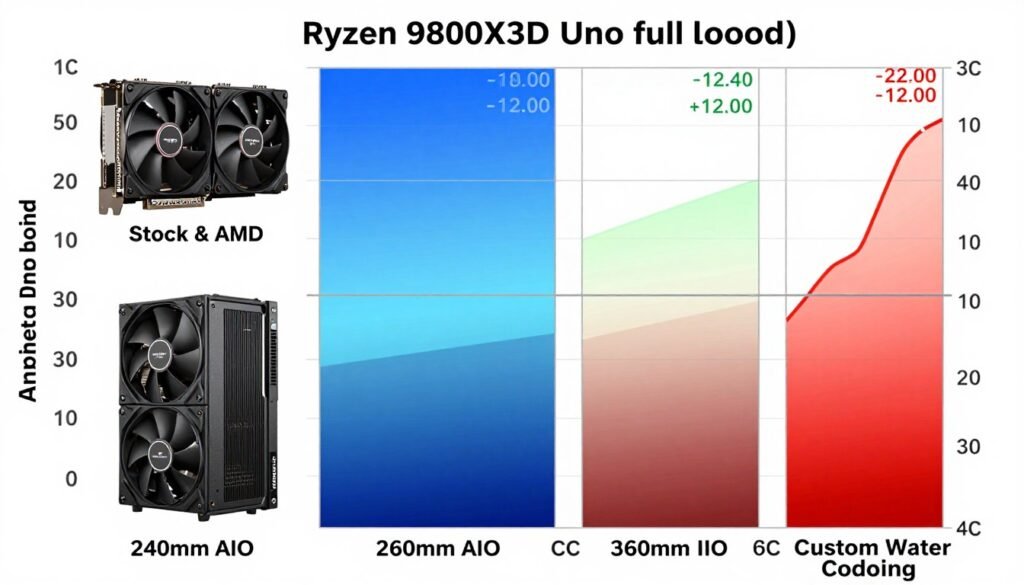
Based on our testing, we recommend the following cooling solutions for the 9800X3D:
- Tower air coolers with at least 4 heatpipes
- 120mm fan diameter minimum
- Adequate for stock operation
- Limited PBO headroom
- Examples: Cooler Master Hyper 212, Arctic Freezer 34
Budget Cooling ($30-60)
- Dual-tower air coolers or 240mm AIOs
- Good PBO overclocking potential
- Quiet operation under load
- Balanced price/performance
- Examples: Noctua NH-D15, Arctic Liquid Freezer II 240
Mid-Range Cooling ($60-120)
- 360mm AIOs or custom water cooling
- Maximum PBO headroom
- Lowest noise levels
- Overkill for most users
- Examples: Arctic Liquid Freezer II 360, EK AIO Elite 360
High-End Cooling ($120+)
Complete Your Ultimate Gaming Build
Ready to build around the Ryzen 7 9800X3D? Explore our curated selection of compatible motherboards, memory kits, and cooling solutions designed to maximize your gaming experience.
Value Proposition and Competitive Analysis
At $480, the Ryzen 7 9800X3D represents a premium option in the CPU market. Understanding its value proposition requires comparing it to both AMD and Intel alternatives across different price points and use cases.
Price-to-Performance Analysis
To evaluate the 9800X3D’s value, we need to consider its performance relative to its price compared to other options on the market.
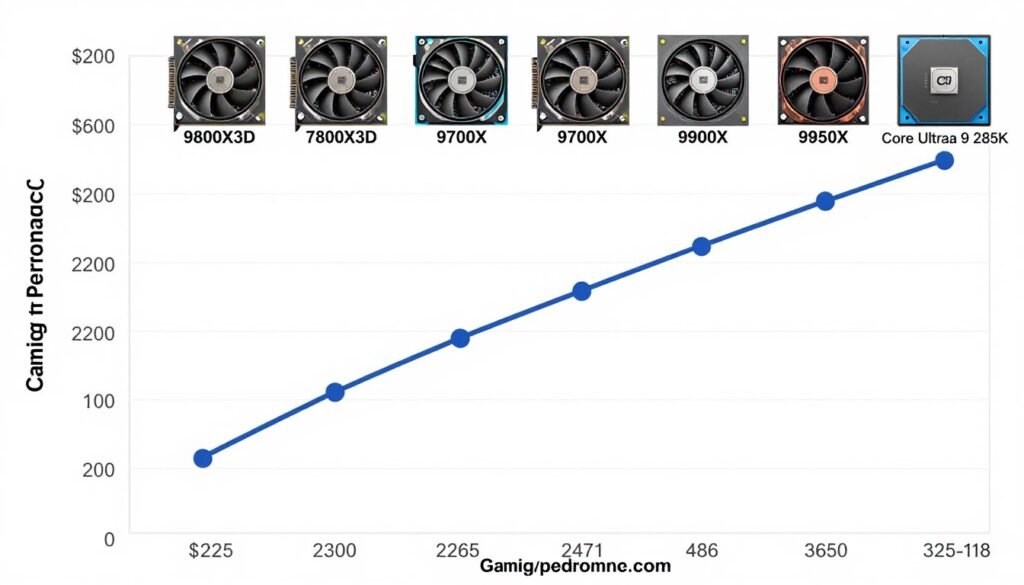
When examining pure gaming performance per dollar, the 9800X3D presents an interesting value proposition:
| Processor | Price (MSRP) | Avg. Gaming Performance | Performance per Dollar | Best Use Case |
| Ryzen 7 9800X3D | $480 | 100% (baseline) | 0.21 | Pure gaming focus, high-refresh competitive |
| Ryzen 7 7800X3D | $450 | 88% | 0.20 | Value gaming on existing AM5 platform |
| Ryzen 7 9700X | $329 | 82% | 0.25 | Balanced gaming/productivity on a budget |
| Ryzen 9 9900X | $499 | 85% | 0.17 | Mixed workloads with productivity focus |
| Core i9-14900K | $589 | 78% | 0.13 | High-end productivity with some gaming |
| Core Ultra 9 285K | $589 | 75% | 0.13 | Latest platform features, AI workloads |
The 9800X3D commands a premium price, but delivers unmatched gaming performance that justifies the cost for enthusiasts. For pure gaming builds, it represents the best option regardless of price, while also maintaining respectable productivity performance.
Competitive Positioning
The 9800X3D occupies a unique position in the market, with different strengths and weaknesses compared to its main competitors.
Advantages Over Intel
- Superior gaming performance by 20-30%
- Lower power consumption and better efficiency
- Cooler operation requiring less robust cooling
- AM5 platform with longer upgrade path
- Better value for gaming-focused builds
Advantages Over Other AMD CPUs
- Best gaming performance in AMD’s lineup
- Better all-around performance than 7800X3D
- Full overclocking support unlike previous X3D models
- Higher sustained clock speeds than 9700X
- Better single-threaded performance than 7000 series
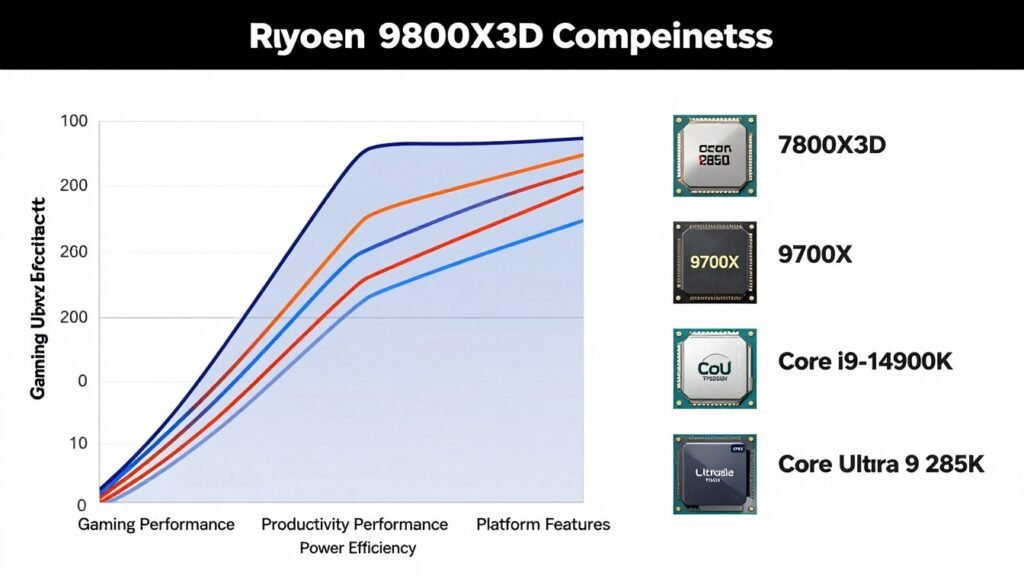
Who Should Buy the 9800X3D?
Based on our analysis, the 9800X3D is an ideal choice for specific user profiles, while other processors may be better suited for different needs.
- Competitive gamers seeking maximum FPS
- High-refresh rate gaming (144Hz+)
- Streamers who game and encode on same PC
- Users upgrading from older Ryzen platforms
- Small form factor builds with thermal constraints
Ideal For
- Primary focus is content creation/rendering
- Budget is limited (consider 9700X)
- Need maximum core count for workstation tasks
- Already own a 7800X3D (modest upgrade)
- Require specific Intel-exclusive features
Consider Alternatives If
Value Perspective: The 9800X3D represents the pinnacle of gaming performance in 2024, and for users who prioritize gaming above all else, it’s the clear choice despite its premium price. However, those with more balanced workloads or budget constraints should carefully consider alternatives like the 9700X or 9900X, which may offer better overall value depending on specific needs.
Ready to Experience Gaming Perfection?
The Ryzen 7 9800X3D delivers unmatched gaming performance with its revolutionary 3D V-Cache technology. Don’t miss out on the ultimate gaming experience.
Frequently Asked Questions
Is the Ryzen 7 9800X3D worth upgrading from the 7800X3D?
For most users who already own a Ryzen 7 7800X3D, the performance improvement offered by the 9800X3D (8-15% in gaming) may not justify the cost of upgrading. However, if you’re using your system for both gaming and productivity tasks, the 9800X3D’s higher clock speeds and improved thermal design provide more substantial benefits in non-gaming workloads, potentially making the upgrade worthwhile. Consider your specific use case and budget before making the decision.
How does the 3D V-Cache technology actually improve gaming performance?
3D V-Cache technology improves gaming performance by significantly increasing the L3 cache available to the CPU cores from 32MB to 96MB. Modern games constantly access various data elements including textures, physics calculations, AI behavior patterns, and game state information. Having this data in the fast L3 cache rather than requiring slower system RAM access reduces latency for critical operations. This is particularly beneficial in open-world games, simulation titles, and CPU-intensive scenarios with many AI entities or physics calculations, where the performance improvement can be as high as 30-40% compared to processors without 3D V-Cache.
What’s the difference between the 9800X3D and the standard 9700X?
The primary differences between the Ryzen 7 9800X3D and the Ryzen 7 9700X are:
- Cache: The 9800X3D has 96MB of L3 cache compared to 32MB on the 9700X
- Clock speeds: The 9800X3D has a higher 4.7GHz base clock (vs 3.8GHz) but lower 5.2GHz boost clock (vs 5.5GHz)
- TDP: The 9800X3D has a higher 120W TDP compared to the 9700X’s 65W
- Price: The 9800X3D costs approximately 0 more at MSRP
- Performance: The 9800X3D delivers 15-30% better gaming performance but similar productivity performance
The 9800X3D is optimized for gaming while the 9700X offers better value for mixed workloads where gaming isn’t the primary focus.
What motherboard should I pair with the Ryzen 7 9800X3D?
For the Ryzen 7 9800X3D, we recommend at least a quality B650E motherboard to ensure adequate power delivery for optimal performance. The sweet spot for most users will be mid-range X670E or new X870 boards, which offer excellent VRM designs, connectivity, and features without the premium price of flagship models. If you plan to use PBO overclocking, look for motherboards with robust VRM cooling. Good options include the ASUS ROG Strix B650E-F Gaming, MSI MPG X670E Carbon WiFi, or Gigabyte X870 Aorus Elite for a balance of features and price. Budget-conscious users can consider quality B650 boards, but may see slightly lower sustained performance under heavy loads.
Does the 9800X3D support overclocking unlike previous X3D models?
Yes, the Ryzen 7 9800X3D fully supports overclocking, which is a significant improvement over previous X3D models like the 5800X3D and 7800X3D that had limited or no overclocking capabilities. This includes support for:
- Precision Boost Overdrive (PBO) with boost clock override up to +200MHz
- Curve Optimizer for per-core voltage optimization
- Manual core ratio adjustments
- Memory and Infinity Fabric overclocking
This overclocking support is possible thanks to the redesigned 3D V-Cache implementation that places the cache underneath the compute die rather than on top, improving thermal transfer and allowing for higher sustained frequencies. However, AMD notes that using these features may void your warranty, so proceed with caution.
What cooling solution do I need for the Ryzen 7 9800X3D?
For the Ryzen 7 9800X3D, we recommend at least a quality tower air cooler with 4+ heatpipes or a 240mm AIO liquid cooler. While the processor runs cooler than many high-end CPUs thanks to its improved thermal design, its 120W TDP still requires decent cooling, especially if you plan to use PBO overclocking. A high-quality air cooler like the Noctua NH-D15 or be quiet! Dark Rock Pro 4 will be more than adequate for most users. For those seeking maximum performance with PBO enabled, a 280mm or 360mm AIO will provide additional thermal headroom and potentially allow for higher sustained boost clocks. The stock coolers that come with some AMD processors are not sufficient for the 9800X3D and are not included in the retail package.
How does the 9800X3D compare to Intel’s latest processors for gaming?
The Ryzen 7 9800X3D significantly outperforms Intel’s latest processors in gaming workloads. Compared to Intel’s flagship Core Ultra 9 285K, the 9800X3D delivers approximately 20-35% higher framerates in CPU-limited gaming scenarios. Even against the Core i9-14900K with its 6.0GHz boost clock, the 9800X3D maintains a 15-30% advantage in most games. This performance gap is particularly pronounced in titles that benefit from the large L3 cache, such as simulation games, open-world titles, and competitive esports games. The 9800X3D also offers better power efficiency, running cooler and consuming less power than Intel’s high-end offerings. However, Intel processors may still hold advantages in certain productivity workloads, particularly those that benefit from higher core counts or Intel-specific instruction sets.
Will the 9800X3D work with my existing AM5 motherboard?
Yes, the Ryzen 7 9800X3D is compatible with all existing AM5 motherboards (X670E, X670, B650E, B650, A620) after a BIOS update. Most motherboard manufacturers have already released BIOS updates to support the 9800X3D and other Ryzen 9000 series processors. Before installing the 9800X3D, check your motherboard manufacturer’s website for the latest BIOS version and update instructions. If you’re currently using a Ryzen 7000 series processor, you can update the BIOS with that CPU installed before swapping to the 9800X3D. If you’re building a new system and the motherboard doesn’t have an updated BIOS, you may need to use a BIOS flashback feature (if available) or contact the manufacturer for assistance.
What memory speed is best for the Ryzen 7 9800X3D?
For the Ryzen 7 9800X3D, DDR5-6000 CL30 offers the optimal balance of performance, stability, and value. While the processor officially supports DDR5-5600, performance testing shows measurable improvements with faster memory up to about DDR5-6000. Beyond this point, the massive 96MB L3 cache helps mitigate the impact of memory latency, resulting in diminishing returns from even faster memory kits. When selecting memory, prioritize lower latency (CL timings) over extremely high frequencies. A DDR5-6000 CL30 kit will typically outperform a DDR5-6400 CL36 kit in most scenarios. For those on a tighter budget, DDR5-5600 CL36 will still provide excellent performance, especially in gaming where the 3D V-Cache helps compensate for memory latency.
Is the 9800X3D good for content creation and productivity workloads?
The Ryzen 7 9800X3D is adequate but not exceptional for content creation and productivity workloads. Unlike previous X3D models that sacrificed significant performance in non-gaming tasks, the 9800X3D’s higher base clock (4.7GHz) and improved thermal design allow it to maintain competitive performance in productivity applications. It performs well in applications that benefit from single-threaded performance or moderate multi-threading, such as Adobe Photoshop, Lightroom, and general office productivity software. However, for heavily threaded workloads like video rendering, 3D rendering, or code compilation, higher core count processors like the Ryzen 9 9900X/9950X or Intel Core i9-14900K will offer substantially better performance. The 9800X3D is best suited for users who primarily game but also need reasonable performance for occasional productivity tasks.
How long will the AM5 platform be supported for future upgrades?
AMD has committed to supporting the AM5 platform through at least 2027+, making it a good long-term investment. This means that if you build a system with the Ryzen 7 9800X3D today, you should be able to upgrade to future Ryzen processors (likely including Zen 6 and potentially Zen 7 architectures) without needing to replace your motherboard or memory. This contrasts with Intel’s approach, which typically introduces new socket designs more frequently. The AM5 platform also offers forward-looking features like PCIe 5.0 support for both graphics and storage, which provides additional future-proofing. However, as with any technology roadmap, AMD’s plans could change based on market conditions and competitive pressures, so this commitment should be viewed as a general guideline rather than an absolute guarantee.
Conclusion: The Ultimate Gaming CPU
The AMD Ryzen 7 9800X3D represents a significant evolution in gaming processor design, building upon the success of previous X3D models while addressing their key limitations. By inverting the 3D V-Cache design to place the cache underneath the compute die, AMD has created a processor that delivers unmatched gaming performance without the compromises in clock speed, thermal performance, and overclocking capabilities that affected earlier generations.
For gamers seeking the absolute best performance available in 2024, the 9800X3D is the clear choice. It consistently outperforms all competitors, including Intel’s flagship offerings, by margins of 15-30% in CPU-limited gaming scenarios. The massive 96MB L3 cache provides particular benefits in complex open-world games, simulation titles, and competitive esports where consistent frame rates are crucial.
Unlike its predecessors, the 9800X3D also maintains respectable performance in productivity workloads thanks to its higher base clock of 4.7 GHz and improved thermal characteristics. While it won’t match higher core count processors for heavily threaded tasks, it’s more than adequate for the occasional content creation, streaming, or productivity work that many gamers engage in.
At $480, the 9800X3D commands a premium price, but delivers performance that justifies the cost for enthusiast gamers. The AM5 platform also offers excellent upgrade potential, with AMD committed to supporting the socket through at least 2027, making it a solid long-term investment.
Pros
- Unmatched gaming performance across virtually all titles
- Improved thermal design enables higher sustained clocks
- Full overclocking support unlike previous X3D models
- Excellent power efficiency compared to competitors
- AM5 platform offers good future upgrade path
Cons
- Premium price point at $480
- Higher core count processors offer better productivity performance
- Requires DDR5 memory, increasing platform cost
- Limited benefit for GPU-bound gaming scenarios
- Modest improvement over 7800X3D may not justify upgrade
In summary, the Ryzen 7 9800X3D represents the pinnacle of gaming processor design in 2024. Its combination of architectural improvements, innovative cache design, and optimized thermal characteristics create a compelling package for gamers seeking the absolute best performance. While not the best choice for every user, particularly those focused on productivity or working with tight budgets, it excels in its intended role as the ultimate gaming CPU.
Experience Gaming Without Compromise
Ready to elevate your gaming experience with the world’s fastest gaming processor? The Ryzen 7 9800X3D delivers unmatched performance for competitive and AAA gaming alike.